What causes carpets to buckle?
Several factors can lead to carpet wrinkling, which we refer to as carpet buckling. Some of these issues are related to installation. Others include temperature and humidity changes, heavy furniture movement, heavy rolling traffic, and damaged or failing bonds in the latex (delamination).
Installation issues
The most common issues we come across are related to the original installation. The labor pricing for carpet installation hasn’t changed much over many decades. Factoring for inflation translates to more jobs needing to be done much faster, which means shortcuts are being taken. Often, the carpet is not adequately installed but “laid” and trimmed to fit. Unless otherwise dictated by the manufacturer, carpets should be stretched 1-1.5%, which translates to 1.2 to 1.8 inches of stretch on a 10-foot span or 2.4 to 3.6 inches on a 20-foot span. That might not sound like much, but it is a significant difference when you have the carpet laid out.
Another commonly overlooked factor for residential carpets is the acclimation of the product before installation. All flooring products need time to acclimate inside the dwelling before installation; carpet is no exception. While this practice is commonly used on commercial properties for carpets, it is often skipped for residential installations, primarily due to the need for more space for a carpet roll to dwell. The unacclimated material could expand and contract due to temperature and humidity changes.
Sometimes, there’s not enough stability underneath the carpet. We have found loose tack-stripping where the anchoring gave way. A common mistake we’ve encountered is concrete nails used to anchor the tack strip to a wood subfloor—it doesn’t hold forever because it wasn’t designed for the material. Longer carpet spans may require wider tack strips with an additional row of pins or two rows of tack strips. Inadequate cushion or padding underneath the carpet can also be an issue.
The old saying, “You get what you pay for,” applies here. If you’re about to purchase new carpeting for your home or business, be wary of big-box stores offering free or discounted installation. Make sure the person(s) installing the carpet are paid well. This is hard, physical, skilled labor and should not be discounted.
Temperature and Humidity Changes
Another factor contributing to carpet wrinkles is humidity and temperature. This can be especially problematic if a stable range is not maintained indoors and the dwelling experiences large swings of humidity and temperature. Here in Sacramento, we have rivers, and our humidity ranges from 53% to 83%, with 66% being the annual average. The ideal humidity level inside a home is 30-50%. Specific areas can get cold in winter. When the inside of a dwelling is allowed to drop below 55 degrees Fahrenheit, this can cause stability issues for the carpet and void the warranty.
Heavy furniture movement or heavy rolling traffic
Dragging heavy furniture across the carpet or rolling traffic may cause wrinkles or bubbles. Moving the item back relieves the bubble if you have just moved furniture. Using extra-large furniture sliders or lifting items off the carpet can help prevent this from happening when moving furniture.
Delamination
Another possibility is that the carpet has delaminated. That means the bond between the primary and secondary backings has given way. We often see this occurring from heavy or untreated pet urine deposits, carpets affected by spills or water intrusions that weren’t dried out quickly enough, solvents being misused, or, rarely, a defect in the latex bond. While re-stretching may improve the appearance, it doesn’t address the issue. Sometimes, we can glue or inject new latex to re-bond between the two backings.
Wavy after a carpet cleaning

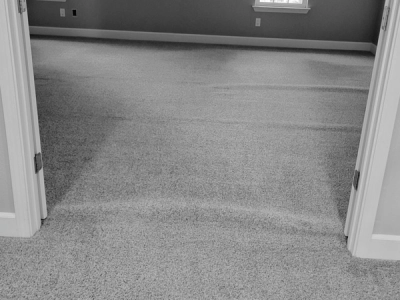
A small but significant percentage of carpets become wavy shortly after being cleaned. This situation can be extremely alarming, but don’t worry—this is not a defect, and nothing is wrong! There’ve been many theories as to why this happens. Still, the most likely cause is the different expansion and contraction rates of the various materials involved in the carpet’s construction. As materials get wet, are exposed to high-temperature water, and begin to dry, they expand and contract differently. This is similar to how the curve is smithed into a Katana sword. There is no need to have the carpet re-stretched in this instance! The carpet will relax and lay flat once it has thoroughly dried.










 01
01


