




How Long Does It Take For A Carpet to Dry After Cleaning?

Freshly cleaned carpet typically takes between 6 and 24 hours to dry, depending on the cleaning method used and how much water went into the carpet. That's the number most guides will give you and stop there. What they won't tell you is that the real question isn't how long does it take the carpet to dry after cleaning.
It's whether your carpet is drying evenly all the way through, because a carpet that feels dry on the surface can still be holding moisture in the padding underneath, and that's where the actual problems start.
How Long Does Each Carpet Cleaning Method Take to Dry?
Not all carpet cleaning puts the same amount of water into your carpet, so not every carpet cleaning method dries at the same speed. A carpet that dries in two hours and a carpet that dries in twenty-four could have been cleaned with the exact same skill and still land on opposite ends of that range. Here's how the common methods compare, including the hot water extraction we use on every residential carpet cleaning job.
| Method | Dry Time | What You Should Know | |
|---|---|---|---|
Hot water extraction (steam cleaning) | 6 to 12 hours, up to 24 with heavy soiling, dense padding, or high humidity | The method most professionals use because it produces the deepest clean. It's what we use at every job. | |
Carpet shampooing | 8 to 24 hours | Leaves more moisture behind than steam cleaning since it wasn't built around strong extraction, which is why it's fallen out of favor with professionals. | |
Dry carpet cleaning | 1 to 4 hours | Minimal water means fast drying, but the tradeoff is a lighter clean that doesn't reach as deep into the fibers. | |
Bonnet cleaning | 2 to 6 hours | Only cleans the surface of the carpet, which is why hotels and commercial properties use it between deeper cleans rather than in place of one. |
If a company tells you your carpet will be dry in an hour after a full deep clean, ask what method they used. Fast dry time and deep clean rarely come from the same process.
What Affects How Long Carpet Takes to Dry?
The method is the starting point, not the whole answer. A handful of other factors decide whether your carpet lands at the fast end of its range or the slow end.
Carpet fiber and thickness. Synthetic fibers like nylon and polyester release moisture faster than wool, which can hold water and take a full day or longer to dry completely. Thicker, denser carpet also holds more water than a low-pile carpet, simply because there's more fiber to saturate.
The padding underneath. This is the gap the opening pointed at, and it's the part homeowners forget about. A damp pad holds onto moisture long after the fibers on top feel fine to the touch, which is why it can take noticeably longer to fully dry than the carpet sitting on it, sometimes by a full day.
Airflow matters just as much. A carpet cleaned in a closed room with no air movement will take considerably longer to dry than one with a window cracked and a ceiling fan running, and humidity works against you the same way, since damp air can't absorb much more moisture from your carpet fibers.
A professional cleaning done right accounts for all of this before the technician ever turns on the machine, which is a big part of why the same carpet can dry in six hours with one company and twenty-four with another.
The equipment doing the extraction. The biggest gap actually lives in the equipment, and almost nobody talks about it. A truck-mounted hot water extraction system pulls dramatically more water out of the carpet during the cleaning itself than a portable rental machine can manage. Less water left behind means less time waiting. It's not just about technique. It's about whether the machine has the suction to back it up, and that's the difference between getting your living room back tonight instead of stepping around a damp carpet for two more days.
How Sacramento Weather Affects Carpet Drying Time
Most articles on carpet dry time are written for a generic climate that doesn't really exist anywhere. Sacramento's isn't generic, and it matters here.
Through the summer, Sacramento runs hot and dry, and that combination is close to ideal for fast carpet drying. Warm air holds moisture well and pulls it out of your carpet efficiently, so a professionally cleaned carpet in July can land at the faster end of the 6 to 12 hour window without much help from you.

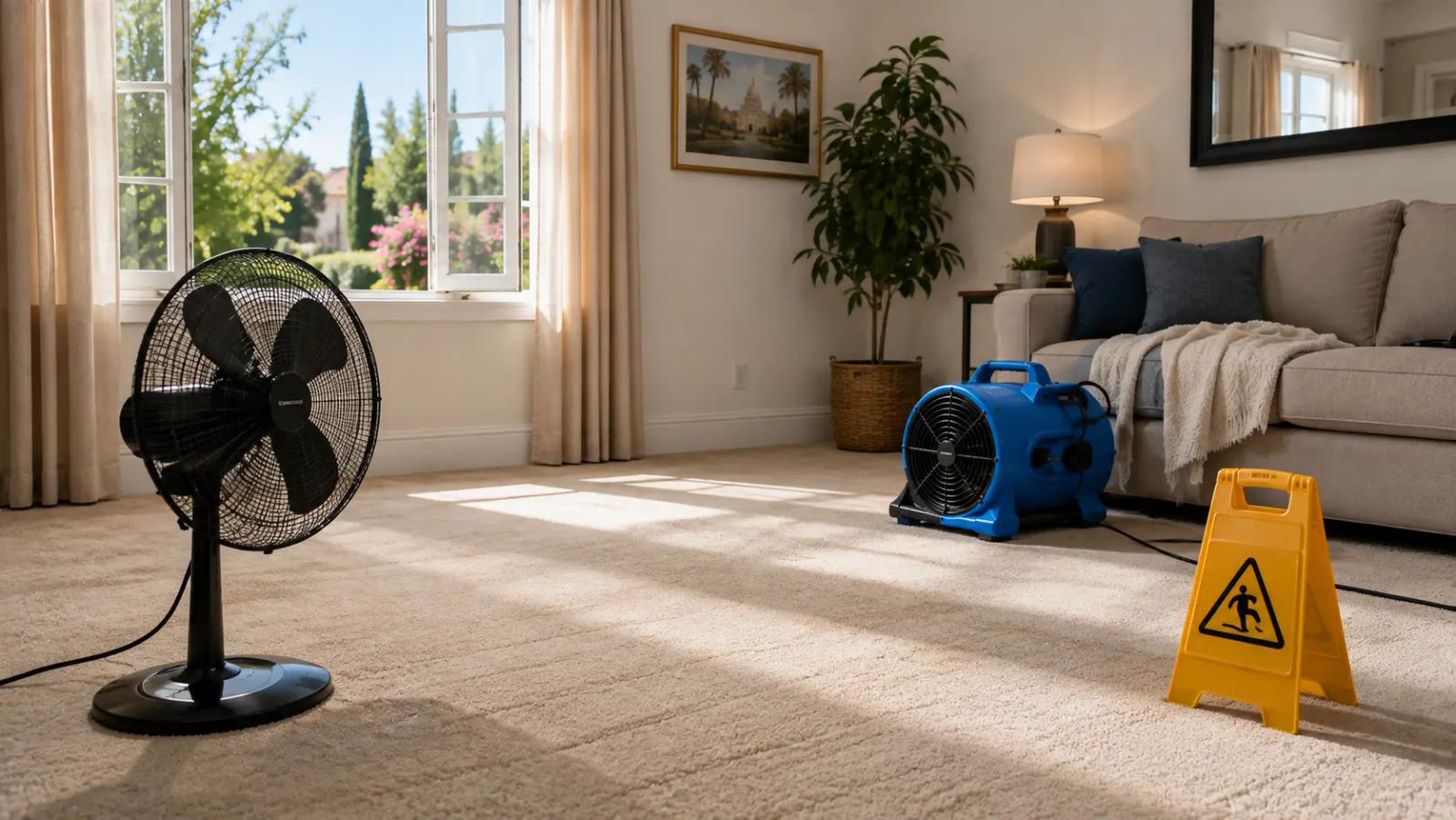
Winter is a different story. Cooler temperatures and higher indoor humidity from closed-up homes slow evaporation down, and carpet cleaned in December or January can take noticeably longer than the same carpet cleaned in August. If your carpet was cleaned in the cooler months and it still feels damp after 24 hours, that's not unusual. It's the season working against you, and it's worth running a fan or your air conditioning's fan setting to move air across the carpet until it's fully dry.
What Happens If Carpet Stays Wet Too Long?
Most guides frame drying time as a scheduling issue: when can you put your furniture back, when can you walk on it normally. That's true, and the bigger risk sits somewhere most homeowners never think to check.
Carpet and padding that stay damp for more than 24 to 48 hours create the exact conditions mold and mildew need to establish themselves, a window backed by EPA guidance on mold and moisture, and once mold gets into a carpet pad, it's rarely something you can clean your way out of. As a Master Fire and Smoke Restorer and IICRC-certified technician, this is the part of carpet cleaning that gets treated as an afterthought far too often. A carpet cleaning job isn't finished when the visible cleaning is done. It's finished when the carpet and the pad underneath it are both properly dry, and that distinction matters more than most homeowners realize until it's already a problem.
If you've ever noticed a musty smell coming back a few days after a carpet cleaning, that's usually not the carpet being "not quite clean." That's moisture that never fully left, sitting in the pad, doing exactly what damp organic material does. A damp carpet that seems fine on day one can still be a problem by day three, and knowing how long it should actually take to dry is what lets you catch that gap.
How to Help Your Carpet Dry Faster
You can meaningfully cut down your dry time without any special equipment.
- Turn on ceiling fans or point a standing fan across the carpet, not just into the room
- Open windows on opposite sides of the house if the outdoor humidity is low
- Run your air conditioning, since it pulls moisture out of the air as it cools
- Avoid walking on the carpet while it's damp, since foot traffic pushes moisture deeper into the fibers instead of letting it evaporate off the surface
- Ask your technician whether air movers were used during the appointment, since professional-grade air movers can cut hours off your total dry time
Signs Your Carpet Didn't Dry Properly
If your carpet is still damp past the window covered above, particularly in Sacramento's cooler months, that's worth a call rather than a wait-and-see approach. The same applies if you notice a musty smell, discoloration, or a spot that stays cold and damp longer than the rest of the room. Those are early signals, not just inconveniences, and catching them early is a lot cheaper than dealing with a mold problem after the fact.
Carpet drying time isn't a throwaway detail. It's one of the only numbers a company can't fake, since the physics behind it don't bend to whatever's convenient to promise. Next time someone tells you a full deep clean will be dry in an hour, you'll know enough to ask why.